A SAMPLE FROM WITNESSES
Discussion Guide Preview
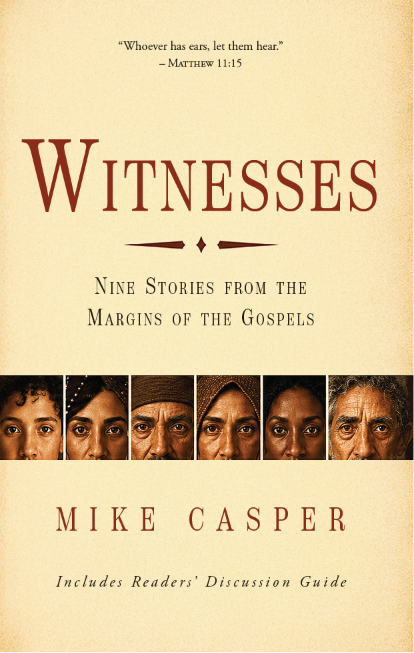
See the exact questions included for “At Jacob’s Well,” the seventh story in Witnesses: Nine Stories from the Margins of the Gospels.
Biblical ContextJohn 4:1–42
HOW TO USE THIS SAMPLE
“No guide knows your group. You do.”
Follow the conversation where it goes. Skip questions that don’t land. Linger on the ones that do.
If a single question sustains forty-five minutes of real discussion, that is a success — let it.
The goal is not to complete the guide. The questions below are a beginning, not a boundary.
01 CONVERSATION GUIDE
At Jacob’s Well
A shorter starting point for relaxed, informal discussion.
A Samaritan woman arrives at a well carrying a lifetime of regrets.
- What makes Gavi such a memorable character?
- Why does Jesus’s conversation with her feel different from many of his other encounters?
- What do you make of Itzhak’s final decision?
- Why does Gavi become such an effective witness despite her past?
Biblical ContextJohn 4:1–42
02 READER’S DISCUSSION GUIDE
At Jacob’s Well
A deeper exploration of character, exclusion, transformation, and witness.
Gavriel — Gavi — comes to Jacob’s Well at the sixth hour because she isn’t welcome when the other women come. She has had five husbands. The town knows her arithmetic. Her current companion, Itzhak, loves her in his own way — a love that’s neither sufficient nor entirely absent. A shimmering blue house gecko watches from the wall. The well is one hundred and forty-nine feet deep, dug by hands that believed water was worth the labor of faith.
- Gavi comes to the well at noon — the ugly sixth hour — because she is excluded from the community of women who come in the morning’s cool. The author doesn’t editorialize about this exclusion. He simply places her there, alone, in the heat. What does this staging accomplish before a single word of dialogue is spoken?
- The well is described as 149 feet deep — a real measurement, historically documented. Why does specificity of this kind matter in a story about a miracle? Consider this: the depth makes Gavi’s daily labor concrete and exhausting. Does that concreteness make Jesus’s offer of water that never runs out more resonant, or does it strain against the miraculous?
- Itzhak is the story’s most complex secondary character. He professes love for Gavi but will not follow her. He raises a bottle in farewell when she walks back toward town, changed. Is Itzhak a villain, a coward, or simply a man with limits? How do you read his bottle salute?
- Gavi’s conversion isn’t dramatic. She doesn’t weep or fall to her knees. She runs, then walks back to town and tells people what happened. Is this a more or less convincing conversion than a dramatic one? Why?
- The story’s central irony is that the woman who comes to the well in shame becomes the person who brings the town to Jesus. Her exclusion is what makes her the messenger. What does the author seem to be saying about the relationship between marginalization and witness?
Biblical ContextJohn 4:1–42
NINE STORIES · TWO COMPLETE GUIDES
Continue the conversation.
The complete book includes discussion material for all nine stories.